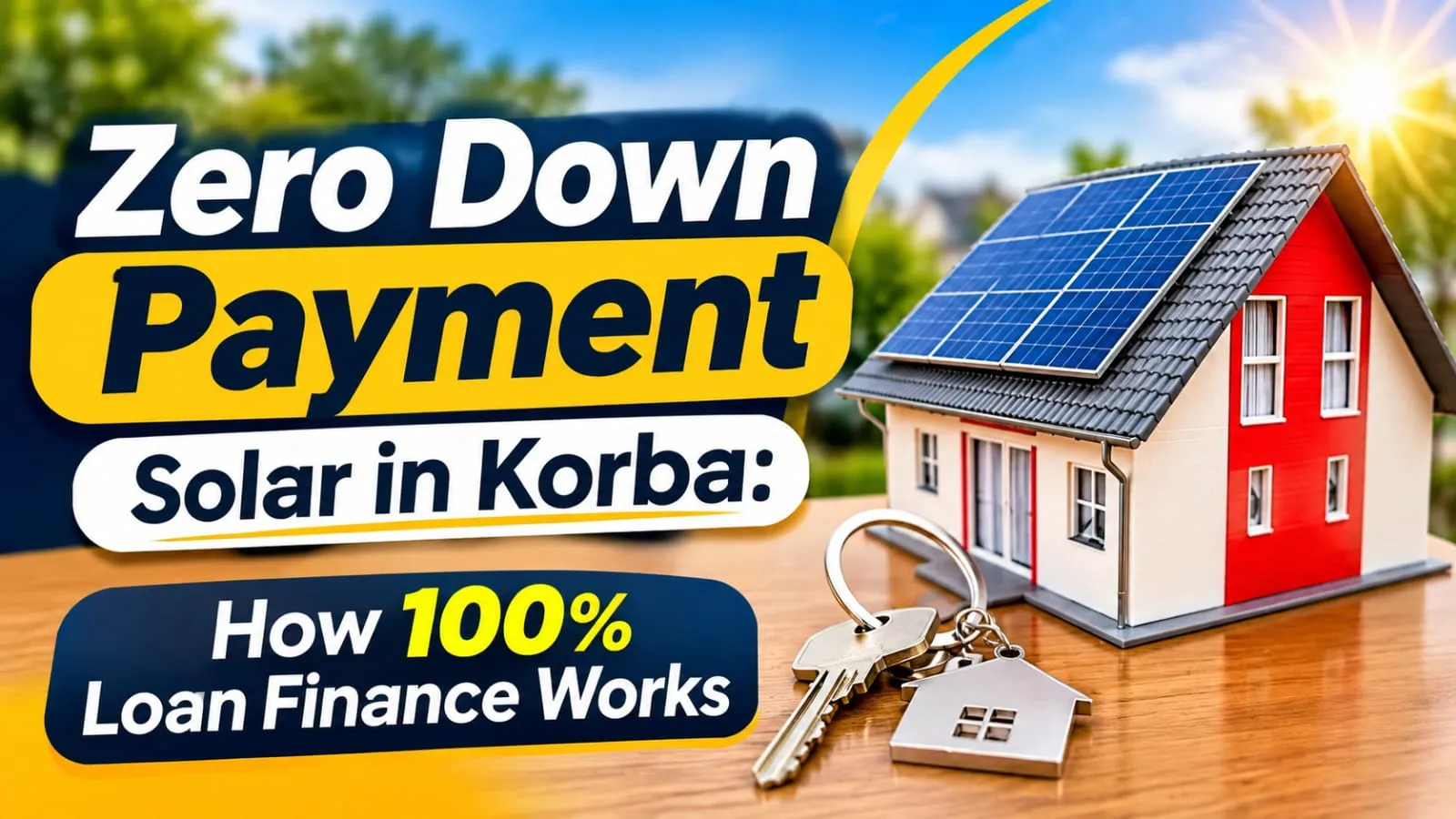
Many Korba families want rooftop solar but hesitate at the upfront cost. Zero down payment solar removes that barrier: 100% loan finance covers the full system price, and the ₹1,08,000 subsidy (₹78,000 central + ₹30,000 Chhattisgarh state) is used to reduce the loan once it arrives. The result is an EMI that is usually lower than the bill saving — so the system pays for itself from the first month.
Key Takeaways
- No upfront payment: 100% of the system price is financed, subject to approval.
- Subsidies of up to ₹1,08,000 are credited after commissioning and can prepay the loan.
- After prepayment, a 3 kW EMI is roughly ₹1,400–1,500 a month.
- A 3 kW system saves about ₹2,000–2,400 a month on average.
- Simple documents: Aadhaar, PAN, bill, bank statement and the quotation.
How zero down payment works
Normally, you would pay for a solar system and then wait weeks for the subsidy. With zero down payment, a bank or lender pays Sunvera for the system on your behalf, and you repay in monthly instalments. You pay nothing on the day of installation. When the subsidies are credited to your account, you use them to prepay part of the loan, which lowers your EMI or shortens the tenure.
A worked example: 3 kW in Korba
| Item | Amount |
|---|---|
| System price | ≈ ₹2,00,000 |
| Down payment | ₹0 |
| Loan amount | ≈ ₹2,00,000 |
| EMI over 7 years at about 7% | ≈ ₹3,000 a month |
| Subsidies credited (central + state) | ₹1,08,000 |
| Loan after prepaying subsidy | ≈ ₹92,000 |
| New EMI, same tenure | ≈ ₹1,400–1,500 a month |
| Average monthly saving from solar | ≈ ₹2,000–2,400 |
Interest rates differ between lenders and change over time, so these figures are illustrative. Your quotation shows the EMI for the lender and tenure you choose.
Why the EMI is less than your bill
A 3 kW system in Korba produces about 360–400 units a month. For a family using a similar amount, the energy portion of the bill falls close to zero in most months. The money you used to pay the electricity board now goes partly to the EMI — and because the EMI after subsidy is lower than the saving, you are better off every month. Once the loan closes, the entire saving stays with you for the remaining life of the panels, which carry a 25–30 year warranty.
Who is eligible
- A direct CSPDCL residential connection in your name (or a family member who applies).
- A roof you own, or the owner's consent.
- Basic credit eligibility as assessed by the lender.
- For the subsidy: a PM Surya Ghar registered vendor and DCR panels.
Homes on internal colony sub-meters cannot claim net metering or subsidy, so check your bill first.
Documents you need
- Aadhaar and PAN
- Latest CSPDCL electricity bill
- Six to twelve months of bank statements
- Salary slips or ITR if the lender asks for income proof
- Proof of ownership or owner's consent for the roof
- Sunvera's quotation with system details
Step by step
- Share your electricity bill; Sunvera recommends a size.
- Site survey and written quotation with EMI.
- Loan application and approval.
- PM Surya Ghar registration and CSPDCL feasibility.
- Installation — usually one to two days.
- CSPDCL inspection and net meter.
- Subsidies credited; prepay the loan to lower your EMI.
Questions Korba families ask
Is there a catch? Interest is paid on the loan, but after the subsidy prepayment the EMI is usually below the monthly saving, so the household is better off overall. What if I want to close the loan early? Ask the lender about prepayment terms before signing. Can I choose a bigger system? Yes; a 5 kW system costs ₹2,75,000–3,00,000 and the subsidy stays at ₹1,08,000, so the EMI after prepayment is higher, but so is the saving.
Comparing zero down payment with paying cash
If you have the money in a fixed deposit, paying cash avoids loan interest — but you also give up the deposit's interest and empty an emergency fund. If the money would otherwise come from a personal loan at a high rate, a dedicated solar loan is far cheaper. For most Korba families, zero down payment is the comfortable middle path: the system is installed now, savings start immediately, and the EMI after the subsidy prepayment is smaller than the monthly saving, so household cash flow actually improves.
What if my bill is small?
Families with bills of ₹600–1,600 a month can choose 1 or 2 kW. A 2 kW system costs ₹1,40,000–1,50,000 and receives ₹90,000 in total subsidy (₹60,000 central and ₹30,000 state), leaving a net cost of about ₹50,000–60,000. With zero down payment, the EMI after prepayment on such a small balance is modest, and the saving still covers it comfortably.
Mistakes to avoid
- Signing with an installer who is not PM Surya Ghar registered — the subsidy will not come.
- Accepting panels that are not DCR — the subsidy inspection can fail.
- Mismatched names on the meter, application and bank account.
- Not asking about prepayment charges before signing the loan.
After the loan closes
Once the last instalment is paid, the full saving — around ₹25,000–29,000 a year for a 3 kW system — stays with your family. Because the panels carry a 25–30 year warranty, that means roughly two decades of near-free daytime electricity after the loan ends. Keep the panels clean, check the monitoring app once a month, and the system will keep delivering.
Start with zero down payment
Sunvera Energy arranges zero down payment solar for Korba homes, handles the loan paperwork, PM Surya Ghar registration, CSPDCL net metering and both subsidy claims. WhatsApp your electricity bill to +91 77103 07937 to get your quotation and EMI.
Frequently Asked Questions
Yes. With 100% loan finance, subject to lender approval, the full system price is financed and you pay nothing on the day of installation.
Roughly ₹3,000 a month over seven years at about 7%, falling to about ₹1,400–1,500 after the ₹1,08,000 subsidy is used to prepay. Actual rates depend on the lender.
Yes. The ₹78,000 central and ₹30,000 Chhattisgarh state subsidies are credited to your bank account after commissioning, whether or not the system is financed.
Aadhaar, PAN, the latest CSPDCL bill, bank statements, income proof if asked, roof ownership proof or consent, and Sunvera's quotation.
Get a free site survey & PM Surya Ghar subsidy guidance.