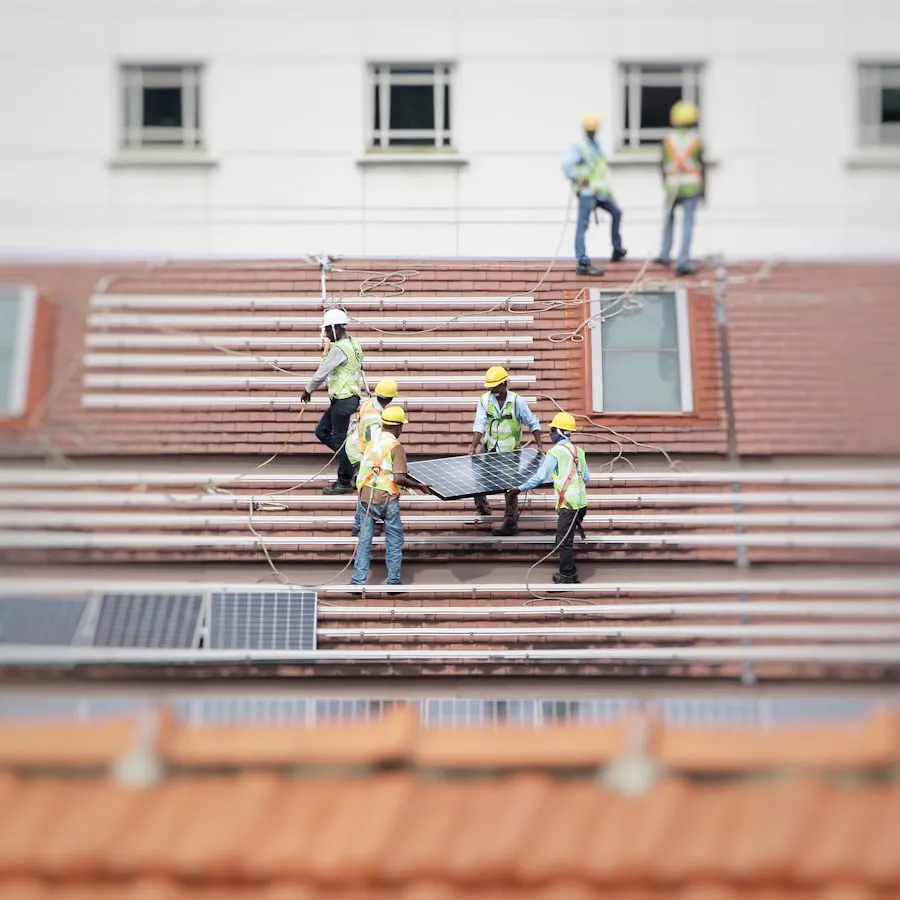
Most rooftop systems in India today use one of three panel types: mono-PERC, the long-time standard; TOPCon, the newer cell technology with slightly higher efficiency and better heat performance; and bifacial modules that also collect light from the back. For a typical home roof, the difference in yearly output between them is a few per cent — important, but less important than correct sizing, a shade-free layout and good installation.
Key Takeaways
- Mono-PERC: proven, widely available, good value — still a sound choice.
- TOPCon: a little more efficient, loses less output in heat and degrades slightly more slowly; usually a small price premium.
- Bifacial: gains depend on mounting height and the surface below; modest on low rooftop mounts, larger on elevated or ground mounts.
- For subsidy projects, the panel must be DCR (Indian cells) whatever the technology.
- Installation quality and shade-free layout matter more than the cell technology.
Mono-PERC — the established standard
PERC (Passivated Emitter and Rear Cell) monocrystalline panels have been the mainstream rooftop module for years. A rear passivation layer reflects unused light back into the cell, raising efficiency over older designs. Mono-PERC panels in the 540–560 Wp range are widely available from major Indian manufacturers, have a long field record, and remain good value. A well-installed mono-PERC system will serve a home reliably for 25 years.
TOPCon — the newer cell technology
TOPCon (Tunnel Oxide Passivated Contact) cells add an ultra-thin oxide layer and a passivated contact on the rear, reducing losses inside the cell. In practice this gives three small advantages: slightly higher efficiency (so more watts from the same area), a better temperature coefficient (less output lost when panels get hot), and typically lower long-term degradation. On a 45 °C day in Gwalior or Bilaspur, when panel surfaces can exceed 65 °C, the better heat performance is a real, if modest, benefit. TOPCon modules usually carry a small price premium over mono-PERC.
Bifacial — light from both sides
A bifacial panel has a transparent back, so it also converts light reflected from the surface below. How much extra it gives depends almost entirely on installation: panels mounted close to a dark roof gain little, while panels raised high over a light-coloured roof, white-painted surface or bright ground can gain noticeably more. Bifacial panels are often heavier and need structures that do not shade their rear side. They make most sense on elevated structures, carports, ground-mounted plants and light-coloured industrial roofs.
Side by side
| Mono-PERC | TOPCon | Bifacial (PERC or TOPCon) | |
|---|---|---|---|
| Efficiency | Good | Slightly higher | Front as per cell type, plus rear gain |
| Heat performance | Standard | Better | As per cell type |
| Degradation | Low | Typically lower | As per cell type |
| Extra yield on a low home roof | — | A few per cent | Small |
| Extra yield elevated / over light surface | — | A few per cent | Can be meaningful |
| Price | Lowest | Small premium | Premium plus structure needs |
The DCR rule matters more for homes
For a residential system claiming the PM Surya Ghar subsidy, the modules must be DCR — made with Indian-manufactured cells — and approved under the government's list. Whatever technology you prefer, the quotation must specify DCR modules with their make and model, or the subsidy will be rejected at inspection. Availability of each technology in DCR form changes as Indian cell manufacturing grows, so confirm it at the time of quotation.
Which to choose
- Typical home, flat roof, subsidy — DCR mono-PERC or DCR TOPCon; TOPCon if the small premium is acceptable and roof space is tight.
- Hot, space-limited roof — TOPCon's heat performance and efficiency help most here.
- Elevated structure, carport or light-coloured roof — bifacial can add useful yield.
- Commercial and industrial plants — compare cost per unit generated over 25 years, not just per watt; TOPCon or bifacial often win at scale.
Half-cut and multi-busbar — other terms you may see
Quotations sometimes mention half-cut cells or multi-busbar (MBB) designs. Half-cut cells are standard cells cut in two, which lowers resistive losses and makes the panel more tolerant of partial shade, because each half of the module works more independently. Multi-busbar designs use more, thinner conductors on each cell to collect current more efficiently. Both are now common on mono-PERC and TOPCon panels alike and are features, not separate technologies — useful, but not a reason on their own to choose one brand over another.
Panel wattage is not panel quality
A 580 Wp panel is not automatically better than a 545 Wp panel — it is usually just physically larger or uses a slightly more efficient cell. What matters for your roof is total system capacity in kW, how many panels fit without shade, and the quality and warranty of the modules. Two systems of the same kW capacity produce about the same energy whether they use fewer large panels or more smaller ones.
What matters more than cell type
A shade-free layout, correct tilt, quality structure, proper cabling, good inverter and regular cleaning each affect output more than the choice between mono-PERC and TOPCon. A premium panel on a partly shaded roof will underperform a standard panel on a clear one. Choose a reputable brand, insist on the make and model in writing, and focus on the installation. Ask for the panel datasheet too: it lists efficiency, temperature coefficient and warranty terms in one place.
Ask us
Sunvera Energy installs modules from Waaree, Adani and Tata, and every quotation names the panel technology, make and model, with DCR modules for subsidy projects. WhatsApp your bills and a roof photo to +91 77103 07937 and we will recommend the panel type that suits your roof and budget.
Frequently Asked Questions
Slightly. TOPCon cells are a little more efficient, lose less output in heat and typically degrade more slowly, giving a few per cent more energy a year. They usually cost a little more. Mono-PERC remains a proven, good-value choice.
Usually only marginally on a low mount over a dark roof. Bifacial panels gain more on elevated structures, carports, ground mounts or over light-coloured surfaces that reflect light onto their rear side.
The technology is not the deciding factor — the modules must be DCR, made with Indian-manufactured cells and on the approved list. Make sure the quotation specifies DCR modules by make and model.
A shade-free layout, correct tilt, quality structure, proper cabling, a good inverter and regular cleaning. These affect yearly output more than the difference between mono-PERC and TOPCon.
Get a free site survey & PM Surya Ghar subsidy guidance.