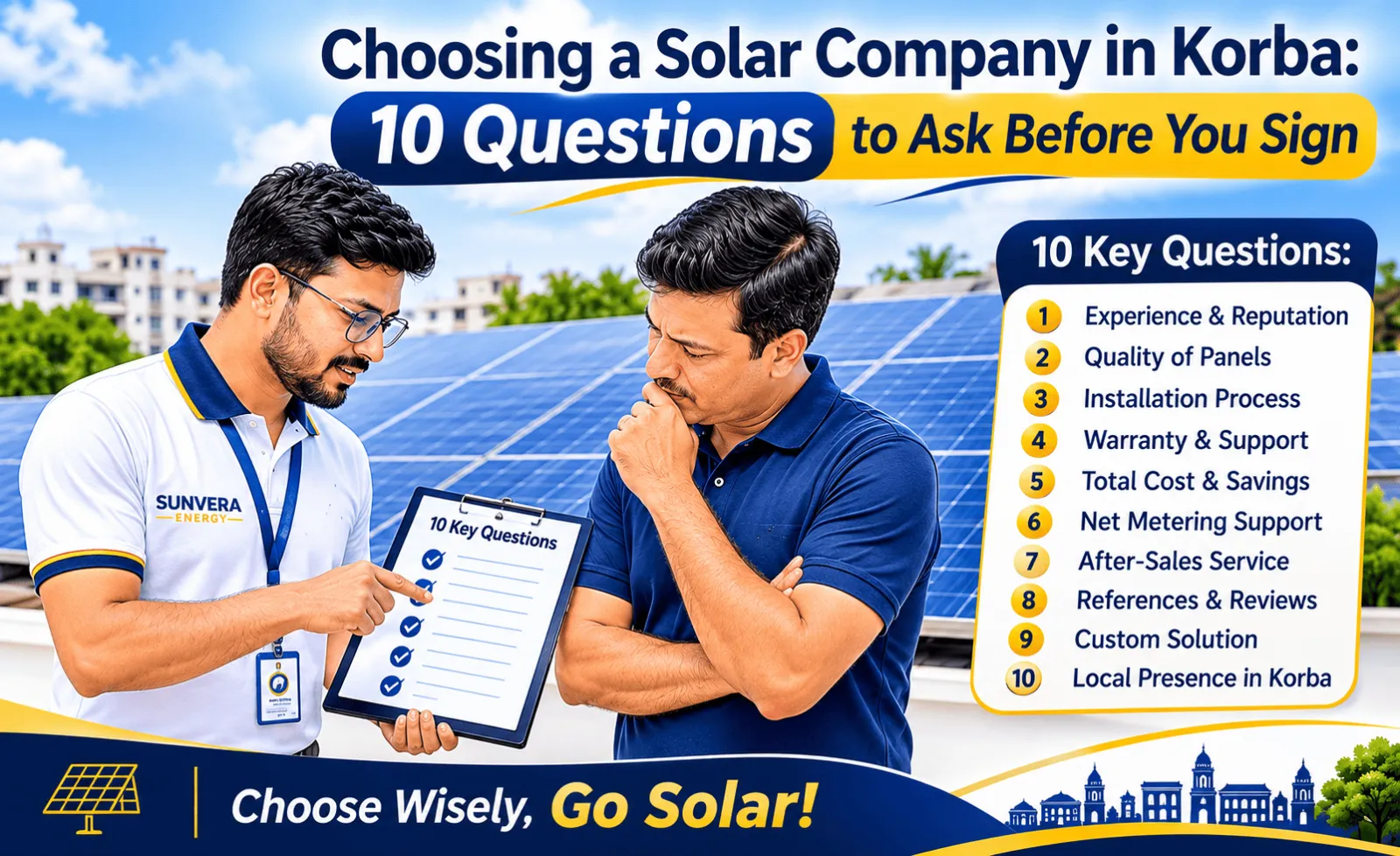
Rooftop solar is a 25-year purchase, and in Korba it comes with local twists — colony meters, coal dust and fly ash, and a double subsidy worth up to ₹1,08,000. The right company gets all of these right; the wrong one leaves you with a stuck subsidy or a dusty system nobody services. Ask these ten questions before you sign.
Key Takeaways
- Insist on a PM Surya Ghar registered vendor and DCR panels named by make and model.
- A good company checks your CSPDCL meter before quoting.
- Get net cost after both subsidies — ₹78,000 central and ₹30,000 state — in writing.
- Ask how dust will be handled and who services the system locally.
- Compare quotations item by item, not by total price alone.
1. Are you registered on the PM Surya Ghar portal?
Only installations by registered vendors qualify for the central subsidy. Ask for the registration and check that the company appears on the portal for CSPDCL. Without it, the ₹78,000 will not come.
2. Will you check my meter before quoting?
In Korba, some homes are on internal colony sub-meters and cannot claim net metering or subsidy. A responsible company asks for your bill first and tells you honestly whether you qualify. A company that quotes without asking is a warning sign.
3. Which panels, exactly?
The quotation should name the panel make, model and wattage, and confirm they are DCR (made with Indian cells) from the approved list. "Branded panels" is not enough. Ask for the datasheet.
4. Which inverter, and what warranty?
Get the inverter make, model and rating, and its warranty in years. Panels carry a 25–30 year performance warranty; inverters usually carry shorter manufacturer warranties. Ask who handles claims.
5. What structure and cables?
Hot-dip galvanised structures resist rust far better than painted ones. Solar DC cable should be UV-resistant and properly sized; household wire is not acceptable. Ask for makes in writing.
6. Is lightning and surge protection included?
Korba's pre-monsoon storms make earthing, a lightning arrester and surge protection on both DC and AC sides essential. A cheap quote often leaves these out.
7. What is my net cost after both subsidies?
For a 3 kW home in Korba, the price is about ₹1,80,000–2,00,000 and the net cost after ₹1,08,000 subsidy about ₹72,000–92,000. Ask for this calculation in writing, along with the EMI if you choose zero down payment.
8. How much will it generate, month by month?
A clean 3 kW system in Korba should give about 4,300–4,500 units a year. Ask for a month-by-month estimate. A company promising far more is either guessing or overselling.
9. How will dust be handled?
Coal dust and fly ash can quietly reduce output. Ask whether the layout allows safe cleaning access, whether the monitoring app will be set up, and what an AMC covers.
10. Who services the system, and how fast?
Ask where the nearest office is, how quickly a technician can reach Korba, and how faults are diagnosed — remote monitoring helps a lot. Get the service phone number before you sign, not after.
Questions about payment and finance
Ask how payment is staged — how much on order, on delivery and on commissioning — and get it in writing. If you choose zero down payment, ask which lender provides the loan, the interest rate, the tenure, any processing fee and whether prepayment with the subsidy carries a charge. A reliable company explains all of this before you sign, and shows the EMI beside your expected monthly saving so you can see that the system pays for itself.
Questions about timelines
Ask how soon the survey will happen, how long installation takes, and what the realistic timeline is for CSPDCL inspection and the net meter. For a 3 kW home in Korba, installation is usually one day, and inspection and meter typically follow three to five weeks later. Be wary of any company that promises the subsidy within days; the process has fixed steps that take weeks.
Ask to see a working system
Nothing replaces seeing an installation the company has already done. Ask for a reference customer in Korba or nearby, or at least photographs of recent installations showing the structure, cabling and earthing. A company that installs carefully is proud to show its work; one that cuts corners usually changes the subject.
How to compare two quotations
| Item | Quote A | Quote B |
|---|---|---|
| Panel make, model, DCR | ||
| Inverter make, rating, warranty | ||
| Structure type and galvanising | ||
| Cable make and size | ||
| Earthing, arrester, surge protection | ||
| Net cost after both subsidies | ||
| Yearly generation estimate | ||
| Service office and AMC |
Fill this in for each quote. Differences in price almost always show up in one of these rows.
After you sign
Keep a folder with the quotation, invoice, panel and inverter warranty cards, the string test results from commissioning, and the portal commissioning report. Ask the company to set up the monitoring app on your phone at handover and to show you what a normal clear-day reading looks like for your system. Check generation after the first month against the estimate you were given. If anything looks wrong, raise it early — a good company will want to fix it while the system is new.
Red flags
- No meter check before quoting.
- Panels not named, or not DCR.
- "Subsidy guaranteed" without explaining eligibility.
- No written generation estimate.
- No local service contact.
Ask Sunvera
Sunvera Energy is a PM Surya Ghar registered solar company serving Korba from its Bilaspur office. Every quotation answers these ten questions in writing. WhatsApp your bill to +91 77103 07937.
Frequently Asked Questions
Choose a PM Surya Ghar registered company that checks your CSPDCL meter first, names DCR panels and all components, gives net cost after both subsidies in writing, and has local service.
Some Korba homes are on internal colony sub-meters and cannot claim net metering or subsidy. Checking first avoids a system that never receives the promised subsidy.
Panel, inverter, structure and cable makes; earthing, lightning arrester and surge protection; net cost after the ₹78,000 central and ₹30,000 state subsidies; a generation estimate; and service details.
No meter check, unnamed or non-DCR panels, a "guaranteed" subsidy without eligibility checks, no written generation estimate and no local service contact.
Get a free site survey & PM Surya Ghar subsidy guidance.